Enter a keyword below to search for articles and products.
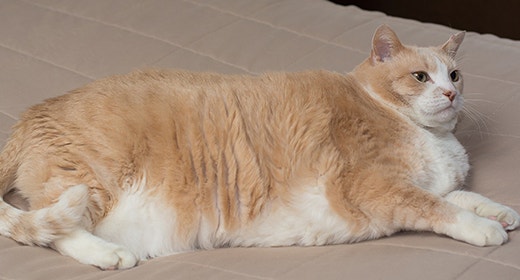
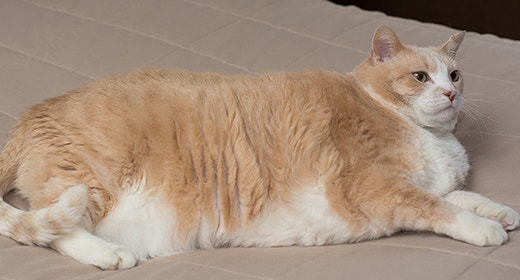
An obese cat is not a pretty sight. Cumbersome and clumsy, they suffer a marked loss in athletic ability and appearance. Decreased flexibility prevents them from thoroughly grooming, which can cause skin problems. Obese cats also have an increased risk for diabetes and are poor candidates for surgery and anesthesia.
Obesity results when an animal consistently eats more calories than they need. This can be caused by overfeeding, inactivity, reproductive status, environment, body type, age or genetics.
Assessing body condition is important in the overall evaluation of your cat’s nutritional well-being and can help in determining feline obesity. Take a few moments to follow the easy directions in the Cat Body Condition Chart for assessing your cat’s body condition.
If you suspect your cat is obese, the first step is to consult your veterinarian.
Your veterinarian will probably ask you some questions about your cat, such as how much they eat and how much physical activity they get. Answering these questions honestly will help your veterinarian recommend some simple changes to help improve your cat’s weight. Your veterinarian may also perform tests to detect medical conditions that may contribute to obesity — you want to rule these out before starting your cat on any weight-management program.
Your veterinarian may first suggest reducing the amount you feed your cat. If so, begin by reducing the daily portion by 25%. Continue decreasing intake by 10% increments every two to three weeks until your cat loses 1% of their starting weight. For example, if your cat weighs 15 pounds, a 1% loss would be 2½ ounces.
If you feed one large meal a day, or keep food available at all times, try dividing the daily ration into several small meals (at least two meals a day) and pick up what your cat doesn’t eat 30 minutes after each meal.
A diet that contains slowly digested carbohydrates, such as corn and sorghum, can result in lower blood sugar and insulin levels than a diet that contains rice as the primary carbohydrate source. Lower blood sugar and insulin levels can also help with maintaining a proper weight.
Changing diets can be stressful for pets, so if your veterinarian recommends changing diets, proceed slowly.
Begin with a daily portion that mixes 25% of the new food with 75% of the old food. The next day, increase the amount of new food to 50% and decrease the amount of the old food to 50%. During the next few days, continue increasing the proportions of the new food and decreasing the amount of old food until the food consists entirely of the new diet. This method increases the likelihood that your cat will accept the new diet and decreases the occurrence of stomach upsets.
Another way to help your cat lose weight is to increase their activity. Provide cat trees for climbing, or teach your cat to play fetch or walk on a leash. Buy or create your own toys that encourage exercise. One ingenious owner tosses her cat’s dry food ration across the room a piece at a time!
You also can use your cat’s natural hunting instinct to help them lose weight. Hide several small portions of their daily food ration around the house. If you have a multilevel home, make your cat use the stairs.
Use your imagination, but be cautious. Don’t let a fat cat get exhausted, overheated or out of breath. Also, keep in mind that a senior cat may not be able to exercise vigorously.
Replace food treats with rewards like playtime, grooming, stroking or conversation. If you cannot resist the fat cat who begs for food at the dinner table, keep them in another room during dinnertime. If you have a multi-cat household, the consistent winner of the food competition sweepstakes is often obese. If this is the case, separate the cats at mealtimes if possible.
Obesity is easier to prevent than to cure, but it is never too late to reverse it — though it requires long-term patience and commitment. Helping cats lose weight is a slow process. If the amount they eat is severely restricted, the cat risks other health problems.
Increased activity, behavior modification (for both you and your cat) and calorie restriction are your best tools for helping an obese cat lose weight. However, it is important to expect a few setbacks and plateaus. It will take at least four months for an obese cat to lose 15% of their starting weight. At that point, have another look at your cat’s body condition and go from there.
Tips for Starting a Weight-management Program for Your Cat
Antioxidants are good for your cat because they play a key role in minimizing damage to cells, including cells of the immune system.
These important, naturally occurring nutrients help maintain health by slowing the destructive oxidative process of cellular molecules. They also can be important in supporting immune responses and vaccine recognition in cats. This may be especially critical for kittens that are being vaccinated while their immune system is still developing.
Additionally, antioxidants can reverse decreases in immune-cell function for senior cats, increasing them back to healthy adult levels.
Antioxidants are nutrients found naturally in the body and in plants such as fruits and vegetables. Common antioxidants include vitamin C, vitamin E and certain compounds called carotenoids (including lutein and beta-carotene). A blend of several antioxidants in moderate amounts may be more effective than high levels of one antioxidant.
As cells function normally in the body, they produce damaged molecules called free radicals. These free radicals are highly unstable and steal components from other cellular molecules, such as fat, protein or DNA, thereby spreading the damage.
This damage continues in a chain reaction, and entire cells soon become damaged and die in a process called peroxidation. Peroxidation is useful because it helps the body destroy cells that have outlived their usefulness and kills germs and parasites. However, when left unchecked, peroxidation also destroys or damages healthy cells.
Antioxidants help prevent widespread cellular destruction by willingly donating components to stabilize free radicals. More importantly, antioxidants return to the surface of the cell to stabilize rather than damage other cellular components.
When there are not enough antioxidants to hold peroxidation in check, free radicals begin damaging healthy cells, which can lead to problems. For example, free radical damage to immune cells can lead to an increased risk of infection.
Because antioxidants play a key role in minimizing damage to cells, such as those that make up the immune system, recent research examined the benefits of certain antioxidants on the immune response of cats. The results of these studies indicated that antioxidants are important in helping cats maintain a healthy immune system.
The research also showed that each antioxidant benefits the immune system uniquely, so one antioxidant at high levels is not as effective as a group of antioxidants acting together.
Antioxidant | Source | Function |
Vitamin E | Plant oil extract, tocopherols | Optimizes immune system’s T-cell activation |
Beta-carotene | Vitamin premix, corn meal, chicken by-product meal and chicken fat | Optimizes types of cells present in the blood, increases antibody levels in the blood and optimizes vaccine recognition |
Recent research also examined the effect of aging on immune responses. The findings indicate that as cats age, immune cell responses may decline. Including antioxidants in your cat’s diet can help reverse the age-related decrease in immune cell function, returning it to healthy adult levels.