Enter a keyword below to search for articles and products.


You remember the first time you met like it was yesterday, but lately you find yourself wondering if your cat has entered the golden years.
Here are some things to know about senior cats, including signs they’re ageing and ways to alter their diets to keep them going strong.
Gasp!
Is my baby ... old?
A 12-year-old cat is equivalent to a 64-year-old human.
This 64-year-old
ran a marathon,
so you never
know.
Just like people, cats often show signs that they're getting older:
• Decreased activity
• Joint weakness
• A picky palate
• Confused by the internet
A complete and balanced diet is important, whether or not your cat has underlying health issues.
We get it. Indoor cats have less opportunity to exercise than outdoor cats. Just don’t let those calories add up to unwanted pounds.
10 extra calories a day = up to 1 pound a year.
Picky eating in older age often comes from a reduced ability to taste and smell. Cats 14 years and older are 15 times more likely to be too skinny.
So make sure you’re feeding your cat a food that’s high in calorie density and as tasty as possible.
Senior cats with heart disease may need a special veterinarian-prescribed food.
Senior cats with kidney issues may need veterinarian-prescribed food that's lower in potassium and protein.
Cats with diabetes may need to eat a special veterinarian-prescribed diet.
Consider adding dry food to your cat’s diet which can help remove plaque buildup.
All adults cats, regardless of age, should be fed a carnivorous diet.
An animal-based protein should be the first ingredient on any cat food label.
Good news: You don’t have to worry about providing additional supplements when you choose IAMS™. All foods are nutritionally complete and balanced.


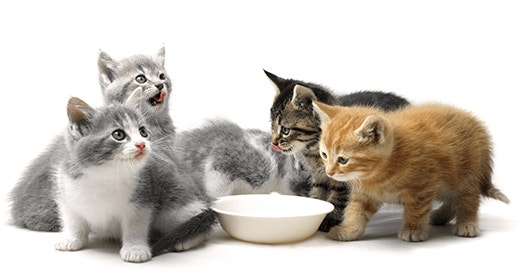
Confused by the ingredient list on your kitten’s food? You’re not alone. Marketing pet foods that have “human-grade ingredients” is becoming commonplace. While appealing to many pet owners, it is important to be aware that the term “human grade” has no legal definition and is used primarily for marketing purposes.
Foods, typically meats, are labeled either as “edible” or “inedible, not for human consumption.” Once a food leaves the human food chain, even if it is of outstanding quality, it has to be labeled “inedible, not for human consumption.” Therefore, meats used in pet food must be labeled as “inedible,” regardless of the source or quality of the meat. The only way to make a pet food with ingredients deemed “edible” is to never let the meat leave the human food chain and actually manufacture the pet food in a human food facility and transport it using human food trucks. Therefore, advertising a product as containing “human-grade ingredients” is untrue if it is not manufactured in a human food facility. However, just because a pet food isn’t marketed as being “human grade” does not mean that the ingredients are poor quality.